Franklin Tree Removal has been trimming and pruning trees in Franklin, TN for more than twenty years, serving surrounding cities including Brentwood, Thompson’s Station, Nolensville, Forest Hills and Oak Hill. Every pruning job we quote names an objective and the cut types that achieve it, in the terms the ANSI A300 standard defines, so what you are buying is written down before anyone puts a saw in the tree.
That matters more than it sounds. “Trim the tree back” describes a mood, not a specification, and two crews given that instruction will produce completely different trees. Crown cleaning, crown raising, crown reduction and crown thinning are four separate jobs with four different results, and paying for the wrong one buys you a tree that still does whatever it was you wanted stopped.
It also matters locally, because Franklin writes excessive pruning and tree topping into its ordinance as violations requiring mitigation rather than treating them as poor practice. A crew that tops a protected tree in this city has created a code problem on top of a structural one. We work every job to A300 objectives and every crew to the ANSI Z133 safety requirements, and neither is negotiable on a residential quote.
Pruning Objectives and Cut Types, Not “a Trim”
Crown Cleaning
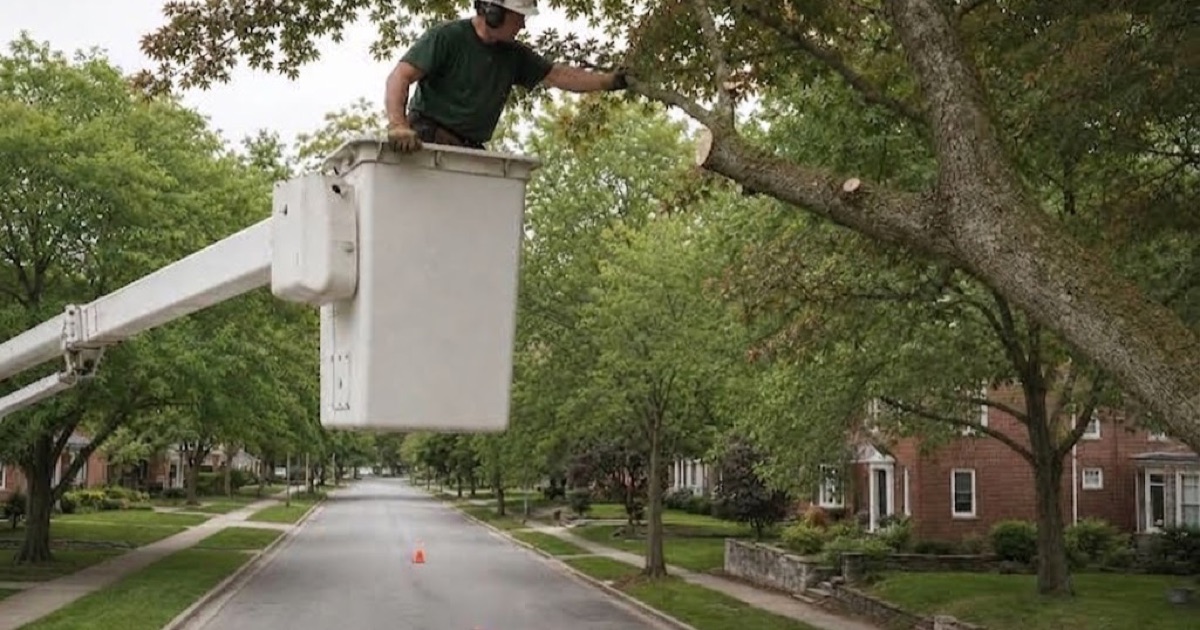
Crown cleaning is the selective removal of dead, dying, diseased and broken branches from the canopy, and on a mature shade tree it is usually the highest-value visit of the lot. It takes out the material that was going to come down on its own timetable, without reducing the live leaf area the tree depends on. Because nothing living is removed, it is also the objective a stressed tree tolerates best.
Crown Raising and Clearance
Crown raising removes the lowest limbs to create clearance under the canopy, over a walk, a drive, a lawn area or a roof line. The discipline is in how far it goes: taking too many lower limbs raises the center of the crown, moves weight higher and leaves a bare trunk that no amount of later pruning corrects. We raise to the clearance you need and stop, keeping a sensible proportion of live crown on the stem.
Crown Reduction and Crown Thinning
Reduction shortens the outer canopy by cutting back to appropriate lateral branches large enough to assume the terminal role, which is how a tree that has outgrown its space is genuinely made smaller. Thinning selectively removes interior branches to move light and air through the canopy without changing its outline. They solve different complaints, and quoting one when you wanted the other is the most common misunderstanding in this trade.
Why We Never Top a Tree
What Topping Does to Structure
Topping cuts a canopy back to stubs with no regard for where the laterals are, which removes the leaf area the tree lives on and leaves large wounds in positions that do not close properly. The tree responds with a dense flush of shoots attached only to the outer wood of the stub. Those shoots grow fast, get heavy and are anchored badly, which is exactly the combination that fails under the next ice load.
Topping Is a Code Matter in Franklin
This city does not leave the question to taste. Excessive pruning and tree topping appear in the ordinance among the violations requiring mitigation, alongside unpermitted removal, and mitigation on a protected tree is measured in replacement caliper inches. A homeowner who hires the cheapest bid on a mature protected tree can end up paying for the pruning, the mitigation planting and the removal of a tree that never recovers.
Reduction as the Service That Actually Solves It
When a tree really is too large for where it stands, crown reduction to proper laterals is the answer, and it is a slower, more selective job than running a saw across the top of a canopy. Done properly it lowers the crown, reduces the sail area presented to wind, and leaves a structure that keeps functioning. Where reduction cannot bring a tree into a safe size, that is a removal conversation rather than a topping one.
Timing, Species and Local Loads
Pruning for Ice Load Rather Than Wind Alone
Ice is the storm mode that produces the failure work in this metro, and it loads a canopy very differently from wind. Ice coats every twig, so the load scales with surface area and lands on the long, horizontal, poorly attached limbs first. Reduction on over-extended laterals and cleaning of the dead wood that ice would bring down anyway are the two objectives that actually reduce what happens in an ice event.
Species Behavior on Local Lots
The canopy over older lots here is largely white oak, post oak, tulip poplar, sugar maple and shagbark hickory, and they do not respond the same way to the same cut. Fast-growing subdivision plantings behave differently again: Callery pear splits at its crowded, narrow unions, and Leyland cypress rarely recovers from cuts made back into old wood. We prune to the species rather than to a single house style.
Utility Clearance and the No Grow Zone
Middle Tennessee Electric serves this city, maintains its rights-of-way with certified arborists on staff, and publishes an Approved Tree List and a Tree Replacement Program for what may be planted near its equipment. Its No Grow Zone rule keeps vegetation 12 feet clear of the front of a pad-mounted transformer and 3 feet clear of the other sides. We prune to those clearances on the customer’s side of the line and leave the conductors to the utility.
Residential Trees, Commercial Grounds and Structural Support
Residential Yards and Mature Shade Trees
On a house lot the work is usually a small number of large trees with specific problems: deadwood over a patio, limbs on a roof, a canopy shading out the lawn, a low branch across the drive. We quote those as named objectives on named trees rather than as a lump sum for the yard, so you can see what each one costs and defer the ones that can wait.
Commercial Grounds, HOAs and Right-of-Way Clearance
Common areas, entrances and parking islands are pruned to a schedule and a budget, and the deliverable a board can use is a plan that says which trees are being cleaned this cycle and which are deferred. Sight lines at entrances, clearance over walkways and fire lanes, and right-of-way clearance along frontages get inspected in the same visit, since those are the items that generate complaints between cycles.
Cabling, Bracing and Deadwooding on Mature Trees
Some structural problems are not pruning problems. A fork with included bark between two co-dominant stems has a union that was never properly joined, and supplemental support hardware installed at the right height spreads that load rather than removing the stems. Deadwooding a large white oak or tulip poplar is often the single highest-value visit on the property, because the risk it removes is concentrated in a handful of identifiable limbs.
- 20+ Years in Middle Tennessee
- Free Estimates
- Written Scope Before We Start