Franklin Tree Removal handles emergency and storm tree removal across Franklin, TN and has done so for more than twenty years, serving surrounding cities including Brentwood, Thompson’s Station, Nolensville, Forest Hills and Oak Hill. Emergency work here means a specific set of jobs: a tree on a house, a trunk across a driveway, ice-broken limbs hanging over a walkway, and the wind-thrown trees that come out of the ground root plate and all.
Our storm planning is built around what this metro actually gets. Ice loading and straight-line wind are the events that produce the failure work here, and both behave differently from the storms a generic emergency script is written for. Winter Storm Fern, which moved through beginning Saturday January 24, 2026 and ran into Sunday, brought snow, sleet and ice together; the Williamson Herald reported close to 15,000 outages across the county by the end of that weekend, about 2,000 of them in Franklin.
The practical consequence for a homeowner is that after an event like that, everyone calls at once. What we can control is triage, honesty about the window, and making the site safe before the full removal is scheduled. What we will not do is take a job the conditions do not allow, because a crew hurt on your property helps nobody.
The First Hour
When the Tree Is on the House
A tree resting on a roof is a loaded structure rather than a fallen one, and the trunk is often the only thing keeping the remaining weight off the framing. Clear the rooms underneath and stay out of them. Do not pull branches, tarp from the roof, or climb up for a better photograph, because every one of those moves the load. Photograph from the ground and from outside, and let the crew stabilize before anything is cut.
When a Line Is Involved
If any part of the tree is touching a conductor, the first call is Middle Tennessee Electric and not a tree service. Only line-clearance qualified crews may work inside the approach distances around energized equipment, and the utility maintains its own rights-of-way with certified arborists on staff. Keep clear of the tree, of puddles near it and of fences it is leaning on, since a fence can carry current a long way from the contact.
When Access Is Blocked
A trunk across the only way out of a driveway is an emergency even with no damage attached, and it is one of the fastest jobs we do. We cut a lane through the trunk, move the sections clear of the travel way, and return for the stump and the fine cleanup on a scheduled visit. Where the trunk crosses a public right-of-way we coordinate the clearance rather than pushing debris into it.
The Storm Modes This Metro Gets
Ice Loading
Ice is the load that produces most of our winter emergency work, and it does not behave like wind. It coats every twig, so the weight scales with surface area and concentrates on long horizontal limbs and on the dead wood that was already there. It arrives on a canopy that is largely unpruned suburban hardwood, which is why a single ice event can take limbs off half the mature trees on a street.
Straight-Line Wind and Tornado Damage
Straight-line wind lays trees down in one consistent direction, which makes the pattern easy to read once you are on site: the survivors standing across that same line are the ones to inspect. Tornado damage is more chaotic, with debris driven into standing trunks and unions torn rather than snapped. Both leave standing trees that look untouched and are not, which is why our first pass is a walk of the whole property.
Windthrow Over a Shallow Root Plate
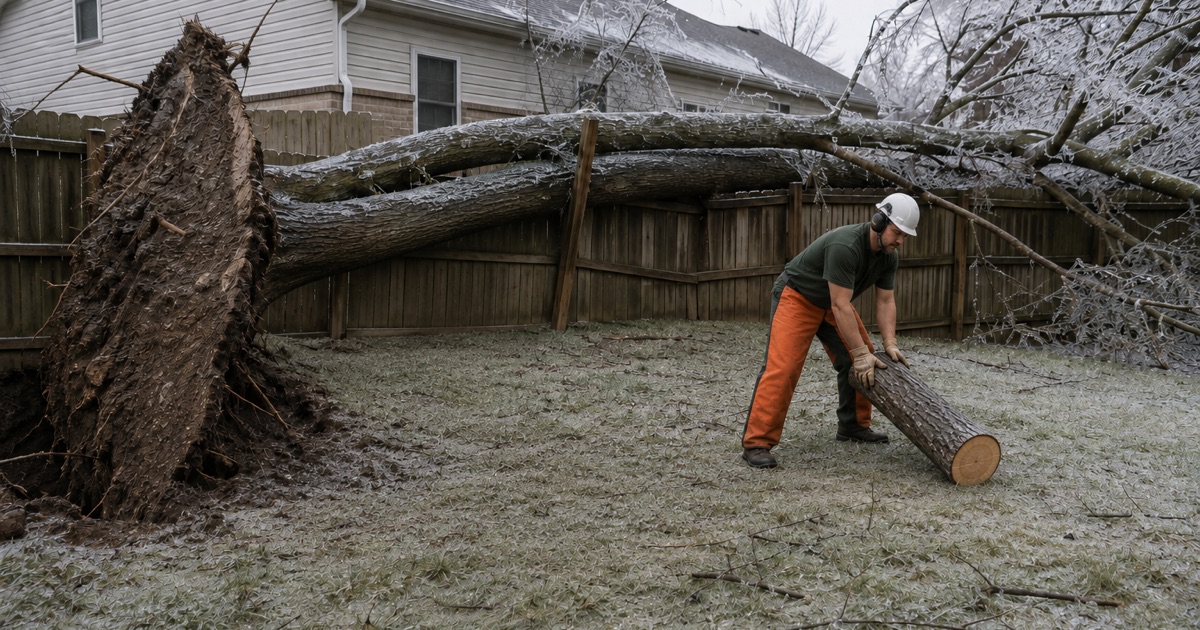
The local failure mechanism is anchorage rather than trunk strength. Where county soils are mapped at around 20 to 22 inches to rock, a tree has no deep anchorage available to it, and saturated soil over that hard interface fails as a plate. The tell is a heaved or cracked mound on the tension side of the trunk. A tree with a lifted plate is finished standing up whether or not it has fallen yet.
How an Emergency Removal Is Worked
Stabilize Before Anything Is Cut
The first cut on a loaded tree is the one that decides how the rest of the job goes. We set lines and supports so the sections that come off do not release stored energy into the structure, then unload the roof or the vehicle progressively and cut the load-bearing piece last. That sequence is the difference between a repairable rafter line and a collapsed one.
Rigging Rather Than Dropping
Almost nothing in a storm job can simply be felled, because the ground under it is a house, a car, a fence or a driveway. Mechanical lowering devices, rigging points set above the load and, where the pick genuinely demands it, a crane are what put a section on the ground under control. We keep crane and spider lift capacity for exactly the trees older lots here tend to carry.
Knowing When to Stand Down
The ANSI Z133 safety requirements govern when aerial work stops, and wind, ice-loaded limbs and nearby energized conductors are all on that list. We will secure a site, tarp an opening, cut an access lane and come back, rather than putting a climber into a canopy the conditions do not allow. Telling you that plainly is part of the service, not a delay tactic.
Permits, Insurance and the Cleanup After
The Weather Emergency Exemption
Franklin’s tree protection standards exempt removals during extraordinary circumstances such as weather-related emergencies and natural disasters, along with trees that threaten a structure, an underground utility or public safety. That means legitimate storm work is not held up by paperwork, but it also means the record matters. We document the condition and the hazard we found so the exemption is supported if anyone asks later.
Documenting the Failure
The evidence an adjuster wants disappears within an hour of the crew arriving. We photograph the position of the trunk before it moves, the fracture surface, the state of the wood inside it and the root plate if the tree came out of the ground, and we write down what we observed. That record travels with the invoice, and it is what turns a description into something a claim can rest on.
Debris and the Post-Storm Backlog
Brush goes through the chipper and trunk rounds are cut to a length you have chosen, hauled or stacked, as the written scope says. The city collects homeowner-cut brush placed in the right-of-way under specific stacking rules, and after a major storm it suspends its usual excess-brush policy. That helps with what a homeowner cuts themselves; anything larger than a self-haul load is a job for a chipper and a truck.
- 20+ Years in Middle Tennessee
- Free Estimates
- Written Scope Before We Start