
Franklin Tree Removal handles land clearing and forestry mulching across Franklin, TN and has worked this ground for more than twenty years, serving surrounding cities including Brentwood, Thompson’s Station, Nolensville, Forest Hills and Oak Hill. The jobs range from a fence line nobody has touched in a decade to a wooded corner being opened for pasture, a trail system, or a building pad on acreage.
Clearing here is governed as much by the ordinance as by the machinery. Franklin requires a tree removal permit on commercial, industrial and multifamily lots of any size and on single-family lots larger than one acre, and Section 17.2.4 sets a minimum canopy retention percentage that changes with the zoning district and with how much canopy the site already has. Getting that mapped before anything is cut is the difference between a clearing job and a mitigation bill.
The ground itself is the other half of the planning. Rock sits close to the surface across much of this county, several areas were phosphate mined into the 1980s, and older cleared parcels frequently hold pushed-up root balls and back-filled pits from bulldozer work. All three change what a machine can do and where it can safely go, so we walk a parcel before quoting it rather than pricing from an aerial photograph.
Forestry Mulching Against Traditional Clearing
What a Forestry Mulcher Does in One Pass
A forestry mulcher cuts standing understory and small-diameter stems and reduces them to a mulch layer where they stood, in a single pass and with one machine. Nothing is stacked, burned or hauled. The mulch left behind holds the soil surface against the first heavy rain, which matters on a slope that has just lost the root mass that was holding it.
Grub and Haul Clearing
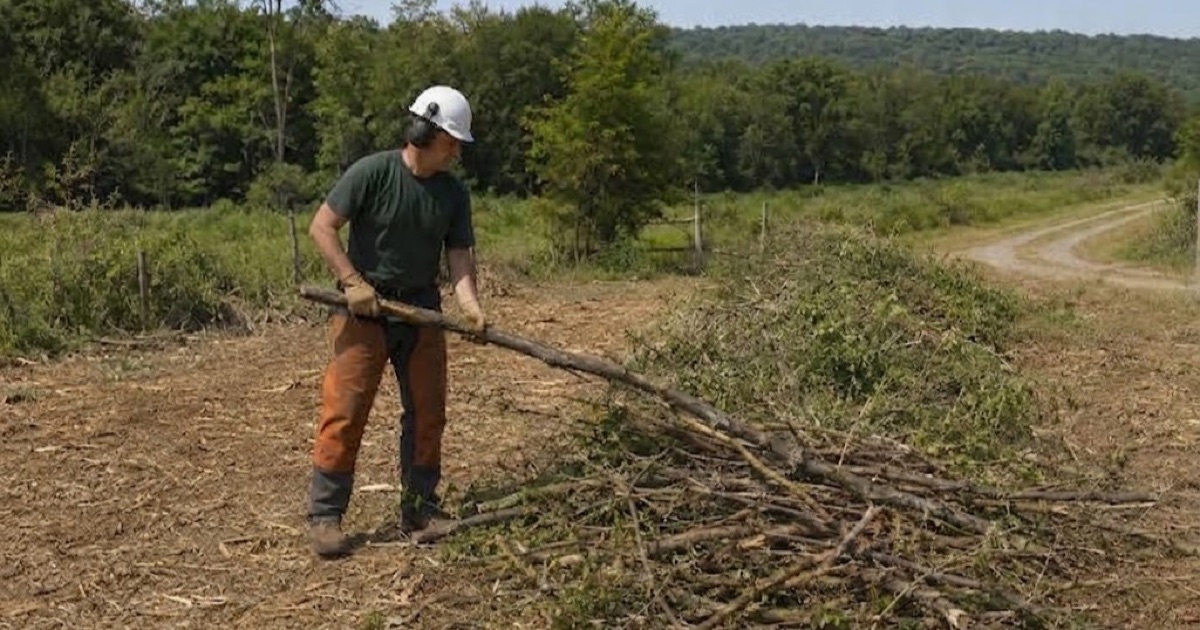
The traditional approach pushes material into piles with a dozer or excavator, then burns or hauls it. It removes root systems along with stems, which is what a building pad or a driveway subgrade actually needs, and it is the only choice where the ground has to be worked to depth. What it also does is disturb the entire surface, generate real disposal cost, and leave a parcel that needs regrading before anything can grow on it.
Choosing Between Them
The deciding question is what happens on the ground afterward. Pasture, trails, firebreaks, hunting lanes and view corridors are mulching jobs; anything structural is a grub-and-haul job. Plenty of parcels want both, mulched across the open acreage and excavated where the pad and drive are going, and splitting the job that way is usually cheaper than doing all of it the expensive way.
Clearing Inside Franklin’s Tree Ordinance
Canopy Retention by Zoning District
The retention requirement is a table rather than a single number, and it moves in the direction most people do not expect: a site that is already lightly wooded has to keep a higher percentage of what it has. In the AG and ER districts that runs from 30 percent on a heavily canopied site to 54 percent on a sparse one. We map existing canopy against the requirement first, then design the clearing around what has to stay.
Permits, Mitigation and the Tree Bank
Removing protected trees without the right approvals is measured in replacement caliper inches rather than fines alone. A specimen tree is mitigated at two caliper inches for every caliper inch removed, other protected trees at one to one, and where the extent of removal cannot be determined the standard is replanting at 80 trees per acre for each acre disturbed. Where the site has no room, the ordinance allows a payment into the City tree bank instead.
Tree Protection Zones on the Trees You Keep
The trees left standing are the ones a clearing job most often kills, and usually by compaction rather than by contact. Protective fencing has to encircle protected specimen trees before land disturbance begins, extending at least one foot per inch of diameter at breast height with a ten-foot minimum, in four-foot chain link with posts no more than ten feet apart and bilingual TREE PROTECTION ZONE KEEP OUT signs at least every 150 linear feet. We fence to that spec and keep traffic outside it.
Ground Conditions on a Local Parcel
Rock, Ledge and Glade Areas
The county’s own regulation describes tabular rock as typical of glade areas, broad and flat and covering large areas, and stair-step or ledge rock as the scenario most typical of hillsides. Rockland is defined as ground where 50 to 90 percent of the surface is exposed rock. All of that decides where a tracked machine can work and where a stump can be taken below grade at all.
Mixed Soil, Old Mining and Buried Debris
Williamson County warns that a mixed soil area covering a large area rather than isolated spots is a sign of past mining, that several areas of the county were phosphate mined into the 1980s, and that the mined sites shown on the 1964 soil survey are not the only ones. It names the other cause directly as well: land cleared with a bulldozer, with stumps and root balls pushed up and pits back-filled. Both mean buried wood and rubble under a surface that looks ordinary.
Slopes, Stormwater and Erosion
Clearing changes where water goes, immediately. Section 17.5.1 requires stormwater management features to be located and designed to avoid tree removal, which puts detention and bioretention layout into the same conversation as tree retention on a development site. On a residential parcel the equivalent question is simpler and just as important: what the first heavy rain does to a slope that no longer has an understory holding it.
The Clearing Jobs We Are Called For
Fence Lines, Trails and Overgrown Boundaries
A fence line left alone for a decade is rarely just brush. It is volunteer eastern redcedar, hackberry and tree of heaven grown up through the wire, with vines that have to be cut off the posts before anything can be pulled. We clear to the line, treat the stumps that would otherwise resprout, and leave a boundary a fence contractor can actually work along.
Pasture Reclamation and Understory by the Acre
Reclaiming a pasture edge or opening a wooded corner is the job forestry mulching was built for, and it is priced by the acre and the stem density. Larger trees inside the area are felled and handled separately rather than fed to the mulcher. The result is ground that can be bush-hogged and grazed rather than a field of stumps waiting for a second machine.
Building Pads, Driveways and Site Prep
Site prep is a sequencing job as much as a clearing one: protect what stays, clear what goes, and get the material off the pad area before grading starts. We coordinate with the grading contractor so tree protection fencing is up before disturbance and so the trees intended to remain are not being driven over the week after they were saved on the plan.
- 20+ Years in Middle Tennessee
- Free Estimates
- Written Scope Before We Start