Franklin Tree Removal handles tree disease treatment and plant health care across Franklin, TN, and after more than twenty years on these lots the first thing we do is refuse to name a disease from the driveway. Most calls that arrive as “my tree is sick” turn out to be a root problem, a soil problem or an insect that is a symptom of something else, and treating the wrong one is expensive and slow.
So the work starts with a diagnosis. That means looking at the root flare rather than the leaves, checking what has been done to the ground within the drip line over the last decade, and reading the pattern of dieback in the crown. A tree declines for a reason, and the reason is usually visible to somebody who knows where to look for it.
It ends with an honest recommendation, including the one nobody sells hard: sometimes the correct answer is that the tree has lost the structure holding it up and no treatment reaches that. We would rather tell you that in month one than after a season of interventions aimed at a problem the tree does not have.
Reading the Symptoms Before Naming the Disease
Conks, Mushrooms and Decay at the Root Flare
A shelf-like conk on a trunk or a cluster of mushrooms at the base is fruiting body evidence, which means the decay behind it is established rather than beginning. At the root flare that matters more than anywhere else on the tree, because that is where the load transfers into the roots. We excavate enough to see the flare, sound the base for hollow tone, and estimate the shell of sound wood remaining.
Dieback, Thin Crowns and Early Color
A crown that thins from the top down, or a tree that colors and drops weeks ahead of its neighbors, is reporting a supply problem rather than a leaf disease. The pattern is the diagnostic part: dieback concentrated on one side points toward root loss or trunk damage on that side, while a uniform thin crown across the whole canopy usually points at the root zone as a whole.
Bark Damage, Exit Holes and Sapwood
Bark that is splitting, sloughing or showing small exit holes is worth a closer look, because insects that bore into the sapwood interrupt the tissue moving water up the stem. What we are checking is whether the damage is a primary cause or a consequence, since many borers colonize trees that were already stressed. That distinction changes the treatment entirely.
Insects That Change What a Tree Is Worth
Emerald Ash Borer and Brittle Ash
Ash killed by emerald ash borer does not behave like other dead hardwood. It goes brittle fast, sheds bark, and fails under a climber’s weight without the warning a decaying oak usually gives. That is why a dead ash becomes a lift or crane job rather than a climb once it is past a certain stage, and why we assess ash on its condition rather than on how long ago it died.
Spotted Lanternfly as a Stressor
The state’s position on spotted lanternfly is worth quoting accurately rather than dramatically: its feeding does not directly cause a tree to decline, but it acts as a plant stressor, and the visible nuisance is honeydew and the sooty mold that grows on it. Populations are confirmed in parts of Middle Tennessee. Treating it as a stressor on an already struggling tree is the correct frame, and panic removal of healthy trees is not.
Tree of Heaven and Why It Goes First
Tree of heaven is the preferred host for spotted lanternfly and an aggressive invasive in its own right, resprouting hard from the roots if it is simply cut off at the base. It also sits on the Tennessee Exotic Pest Plant Council list, which Franklin’s ordinance names among its removal exemptions. Removing it properly means addressing the stump and the root suckers, or you will clear the same thicket again next year.
Soil and Root Problems That Look Like Disease
Buried Flares and Girdling Roots
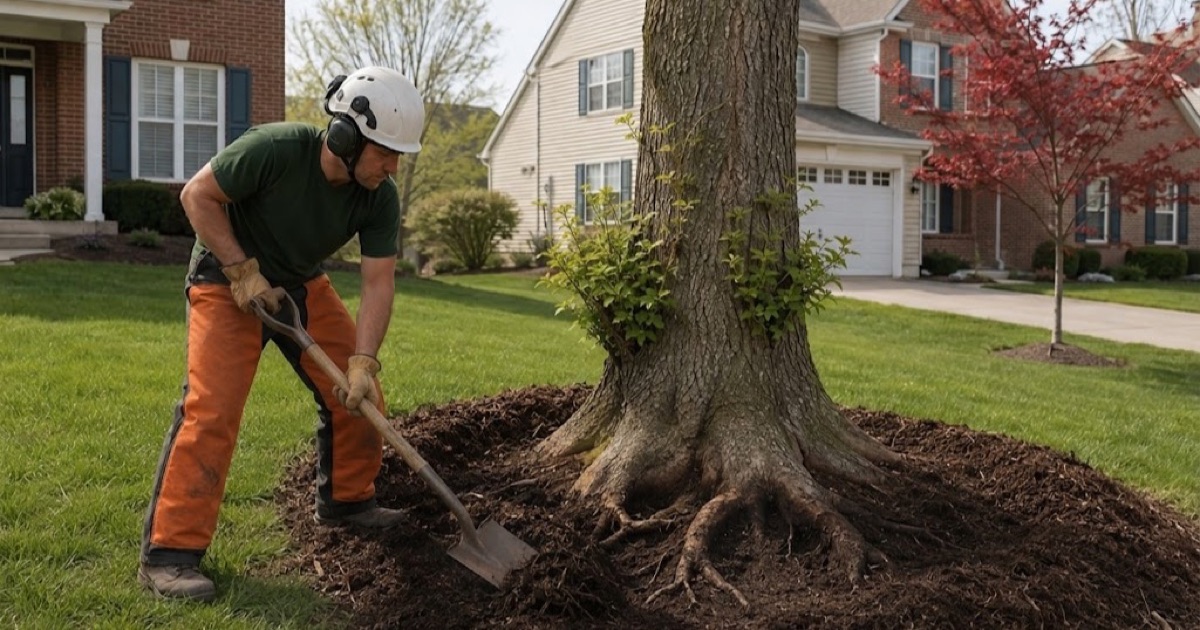
A trunk buried by fill, grade change or years of mulch piled against it holds moisture against bark that was never meant to stay wet, and roots that circle the stem can slowly strangle the tissue underneath. Neither shows above ground until the crown starts thinning. Root collar excavation with an air spade removes the soil without severing roots, exposes the problem and, on a tree caught early enough, reverses the trend.
Compaction and Soil Decompaction
Roots need air, and compacted ground has very little of it. Construction traffic, parking, paving and simple years of use squeeze the profile within the drip line, and the tree responds with poor extension growth and a thinning crown. Loosening the profile with an air spade, on a pattern that respects the existing roots, is a slow-acting treatment with a better record than most of the things sold as tonics.
When Treatment Is Not the Answer
Structural Loss That Nothing Reverses
Decay that has consumed the base, a root plate that has already lifted, or a union that has torn are not conditions any treatment addresses. Where county soils sit around 20 to 22 inches to rock, a tree with a compromised root plate has no deep anchorage in reserve either. At that point the useful service is a clear explanation and a removal plan, not another season of watching.
What Happens to the Wood
Once a diseased or infested tree comes down, Tennessee places no restriction on moving or disposing of wood cut within the state, since the emerald ash borer, pine beetle and thousand cankers quarantines were repealed in 2021. Brush is chipped and hauled, and trunk rounds go wherever the written scope says. Borer-killed ash is already dry and burns sooner than green oak, if you were planning to keep it.
- 20+ Years in Middle Tennessee
- Free Estimates
- Written Scope Before We Start