
Franklin Tree Removal has provided arborist services and tree risk assessment across Franklin, TN for more than twenty years, serving surrounding cities including Brentwood, Thompson’s Station, Nolensville, Forest Hills and Oak Hill. The work here is diagnostic rather than mechanical: measuring a tree, inspecting what holds it up, and putting the condition in writing so a homeowner, an insurer or a city reviewer is reading facts instead of impressions.
Most calls arrive as a single question. A limb came down and the owner wants to know what else is loose, or a buyer’s inspector flagged a leaning oak. A neighbor’s dead tree overhangs a driveway and nobody wants to be the one who guessed wrong. Each of those has an answer that can be measured, and each has a very different cost depending on whether it is answered now or after the tree comes down.
What separates a useful assessment from a walk-around is the record it leaves behind. We document diameter at breast height, the defects we find and where they sit on the tree, the condition of the root flare, and the target the tree would land on if it failed. That document is what a claims adjuster, a plat reviewer or a neighbor can act on, and it is what makes a recommendation to keep a tree as defensible as a recommendation to remove one.
What a Tree Risk Assessment Actually Looks At
Root Plate, Root Flare and Anchorage
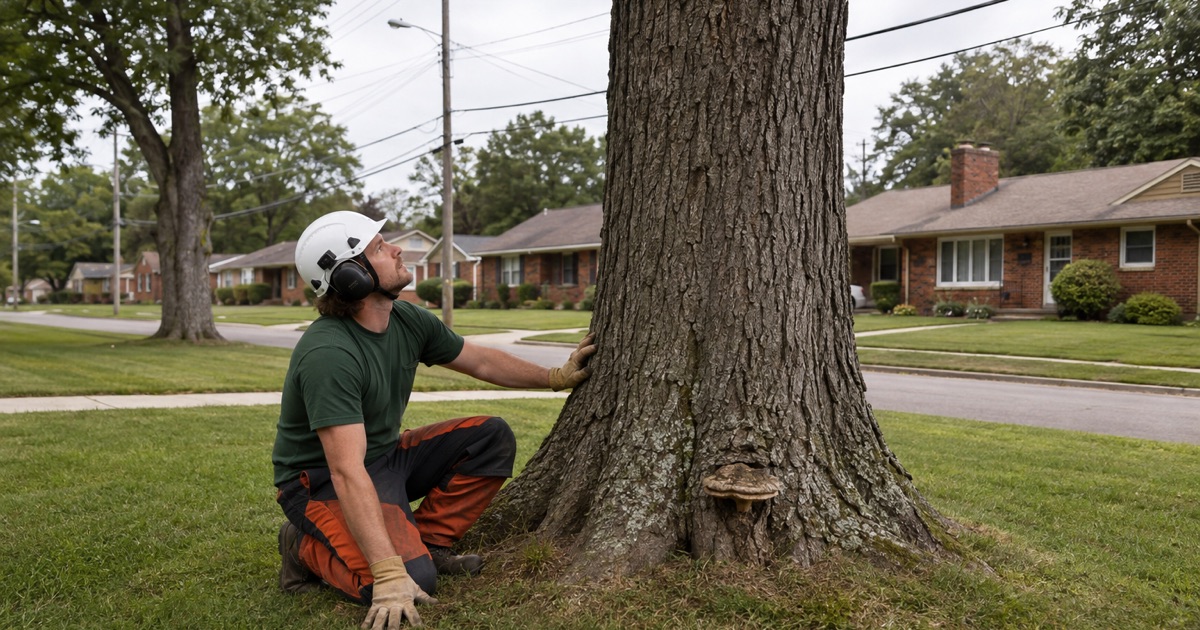
The base of the tree decides more outcomes here than the crown does. Where county soils are mapped at 20 to 22 inches to rock on a Talbott series, a tree has no deep anchorage available and its root plate is a shallow disc over a hard interface. We look for soil cracking or heaving on the tension side, a flare that has been buried by fill or mulch, and conks or fruiting bodies at the collar, because that combination is the local windthrow mechanism rather than a textbook one.
Trunk Defects, Cavities and Included Bark
On the stem we are measuring the shell of sound wood left around any decay, and locating the unions that will fail first. Co-dominant stems with included bark between them are the classic weak point, because the bark inclusion means the two leaders were never structurally joined. Sounding with a mallet locates cavities by the change in pitch, and an existing opening lets us probe the remaining wall thickness rather than estimate it from the outside.
Crown Condition, Deadwood and the Target Below
A defect only matters in proportion to what sits under it, so half of the assessment is about the target rather than the tree. Deadwood over a driveway is a different problem from the same deadwood over a back fence line. We record dieback in the upper crown, hangers already lodged in the canopy, and limbs whose attachment angle and length put real leverage on a weak union above something you use every day.
Levels of Assessment and the Written Report
Limited Visual and Basic Assessments
A limited visual assessment is a fast look at many trees from a defined vantage, and it is the right tool for a first pass over an HOA common area or an acreage boundary. A basic assessment is the standard single-tree inspection: a complete walk around the tree, the ground under it and the visible root zone, with the crown examined from more than one angle. Most residential questions are answered at this level.
Advanced Assessment and Root Collar Excavation
When the basic inspection raises a question it cannot close, the next step is targeted rather than general. Root collar excavation with an air spade removes soil from the flare without severing roots, which is the only way to see buried decay and girdling roots on a tree that has been mulched against the trunk for years. Decay detection on the stem and load assessment on a suspect union fall in the same tier of work.
The Written Condition Report
Every assessment ends in a document rather than a conversation in a driveway. It records what was inspected, what was found, what the report does not cover, and what we recommend and why, with the measurements behind each conclusion. That is the form a consulting arborist report takes, and it is the form that is still useful in six months when the tree, the neighbor or the adjuster raises the question again.
Assessments That Answer a Code or Insurance Question
Condition Verification Under Section 17.2.1
Franklin’s tree protection standards carry an exemption for a tree determined unhealthy by the Department of Planning and Sustainability, or with written verification of its condition as dead, dying or structurally unsound prepared by a certified arborist. Nuisance trees, trees threatening a structure or an underground utility, trees encroaching a utility easement and weather emergencies are exempt as well. Knowing which exemption applies is what keeps a legitimate removal from being processed as a violation.
Specimen Trees, Critical Lots and Critical Root Zones
A specimen tree cannot be cut, pushed over or otherwise harmed except by exemption, and work inside its critical root zone requires documentation from an ISA Certified Arborist that no harm will result. A residential lot holding one is designated a critical lot on the final plat, which strips the one-acre exemption from that lot. Mitigation for damaging a specimen tree runs at two caliper inches of replacement for every caliper inch removed.
Neighbor Disputes and Documented Liability
A healthy tree that fails in a storm is treated very differently from a tree whose decline was on the record and left standing, so the value of an inspection is largely in its date. We inspect from the property we are asked onto, describe the visible indicators, and deliver the findings in writing. A dated report delivered to a tree’s owner changes the conversation before a failure rather than after it.
Residential Yards, HOA Common Areas and Development Sites
Residential Property Assessments
On a house lot the usual scope is a handful of mature trees close to a structure, a drive or a play area, plus whatever the owner has been quietly worrying about. We inventory those individually and give the rest of the yard a walk-through note. The output is a short list ranked by urgency, so a homeowner can do the one tree that matters this month and schedule the rest.
HOA and Commercial Property Inventories
Common areas, entrance plantings and parking islands are managed by budget cycle, which means the useful deliverable is a prioritized inventory rather than a verdict on one tree. We record location, species, diameter at breast height, condition and recommended action per tree, so a board can defend both the work approved and the work deferred. Right-of-way clearance and sight-line obstructions get flagged in the same pass.
Construction Sites and Tree Protection Plans
On a development parcel the assessment happens before the grading, not after it. We identify the protected and specimen trees, map critical root zones against the proposed disturbance, and specify the fencing and signage the ordinance requires. Franklin also requires stormwater management features to be located and designed to avoid tree removal, which puts detention and bioretention layout into the same conversation as tree retention.
Our Step-by-Step Assessment Process
Scope the Question First
We start by establishing what decision the report has to support: a removal, a permit exemption, a claim, a purchase, or a board vote. The level of assessment and the depth of documentation follow from that, and settling it up front is what keeps you from paying for an advanced inspection to answer a basic question.
Inspect the Site, Not Only the Tree
On arrival we walk the ground under and around the tree before looking up, checking soil condition, grade changes, trenching, paving over the root zone and any evidence of a lifted plate. Site history explains a large share of decline in this county, where re-worked ground with buried wood and rubble is a real possibility on an older cleared parcel.
Measure and Record
Diameter at breast height, height and crown spread, defect locations and sizes, and the target under each defect all get recorded on site rather than reconstructed later. Photographs are taken from consistent positions so a follow-up inspection can be compared against this one rather than described against it.
Assess and Rank
Findings are ranked by the combination of likelihood of failure and what sits beneath, which is why a badly decayed tree in an open field can rank below a modest defect over a driveway. Ranking is what makes the report usable as a budget rather than a list of concerns.
Deliver in Writing, Then Discuss
The report goes out before the phone call, so you read the findings without a salesperson narrating them. We then walk through the options, including the ones that keep the tree: crown cleaning, crown reduction, cabling and bracing, root collar excavation or soil decompaction. If removal is the recommendation, the reasoning is on the page you already have.
- 20+ Years in Middle Tennessee
- Free Estimates
- Written Scope Before We Start